moo
Welcome to the moo documentation. moo is a small, self-contained AI agent written in C — plus the foundation libraries it rides on. It ships as a terminal app (moo) that talks to any OpenAI-compatible endpoint (Kimi, GLM, DeepSeek, OpenAI itself, …); an Anthropic-compatible provider is on the roadmap. Runs on macOS and Linux; Windows is on the roadmap but not a near-term priority.
- Designed and reviewed by @mivinci
- Coded by CodeBuddy (VSCode plugin) with claude-opus-4.7 and GLM-5.1
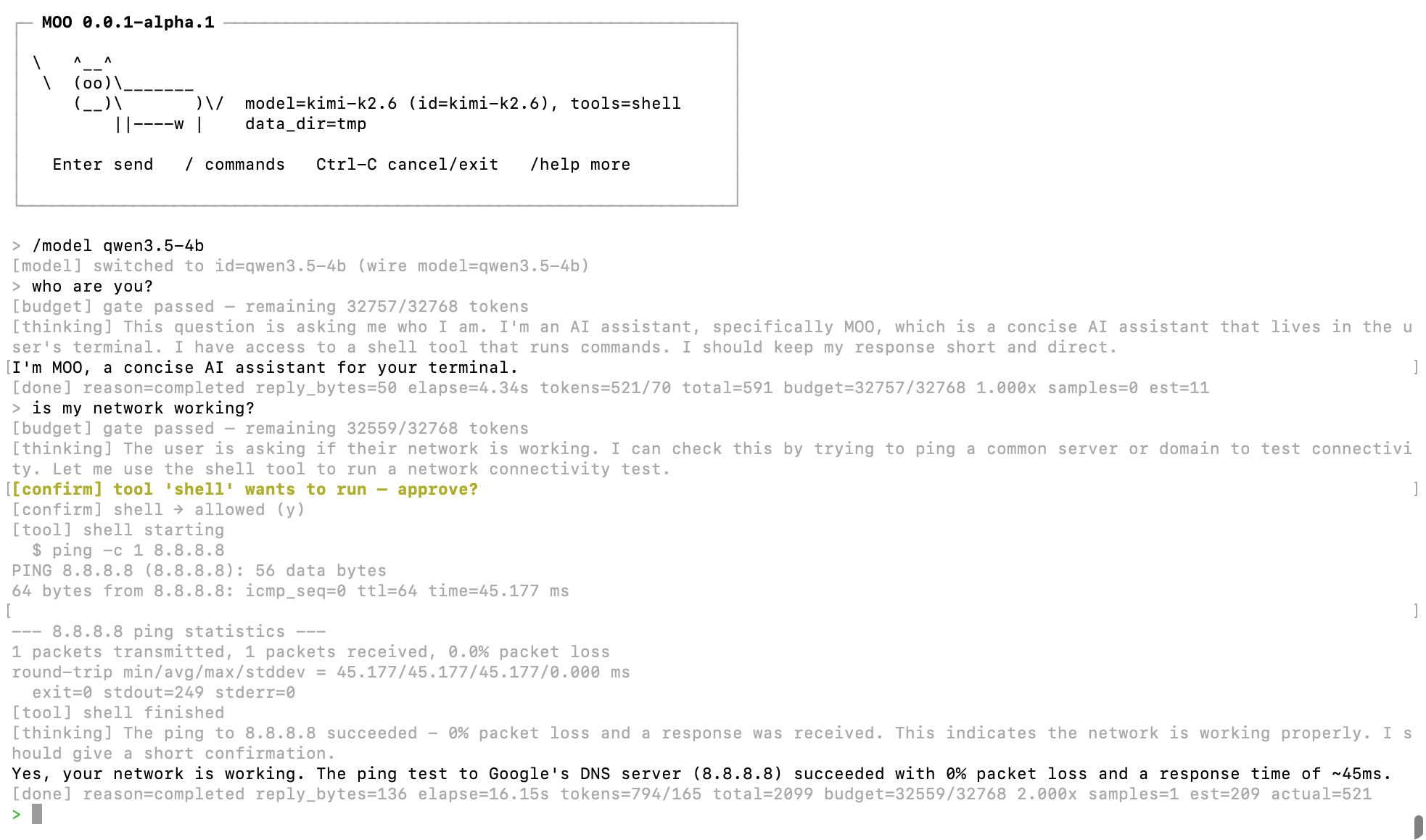
Here's what a session looks like:
Architecture Overview
moo is layered. The agent core (xagent) sits on top of a set of reusable C libraries that together form the runtime: an event loop, buffers, networking, HTTP, logging, a line editor, and more. Each lower-level lib is independently usable in your own project.
graph TD
    subgraph "App Layer"
        APP["cli<br/>the moo REPL"]
    end

    subgraph "Agent Core"
        XAGENT["xagent<br/>agent / session / query /<br/>message / model / provider / tool / budget"]
    end

    subgraph "Foundation Libraries"
        XHTTP["xhttp<br/>HTTP client & server<br/>SSE · WebSocket · TLS"]
        XNET["xnet<br/>URL / DNS / TLS config / TCP"]
        XBUF["xbuf<br/>Buffer Primitives"]
        XLINE["xline<br/>CJK-aware line editor"]
        XLOG["xlog<br/>Async Logging"]
        XCRYPTO["xcrypto<br/>SHA-1 / SHA-256 / MD5 / HMAC / CRC-32"]
        XJS["xjs<br/>Embeddable JS (QuickJS-ng)"]
        XP2P["xp2p<br/>ICE / STUN / TURN / SCTP / DTLS"]
        XFER["xfer<br/>P2P file transfer (WebRTC DataChannel)"]
        XBASE["xbase<br/>Event loop · Timers · Tasks · Sockets · Memory"]
    end

    APP --> XAGENT
    APP --> XLINE
    XAGENT --> XHTTP
    XAGENT --> XBASE
    XAGENT --> XBUF
    XHTTP --> XNET
    XHTTP --> XBUF
    XHTTP --> XBASE
    XNET --> XBASE
    XLINE --> XBASE
    XLOG --> XBASE
    XCRYPTO --> XBASE
    XJS --> XBASE
    XP2P --> XNET
    XP2P --> XCRYPTO
    XP2P --> XBASE
    XFER --> XP2P
    XFER --> XHTTP
    XBUF -->|"atomic.h"| XBASE

    style XAGENT fill:#e67e22,color:#fff
    style APP fill:#c0392b,color:#fff
    style XBASE fill:#50b86c,color:#fff
    style XBUF fill:#4a90d9,color:#fff
    style XNET fill:#e74c3c,color:#fff
    style XHTTP fill:#f5a623,color:#fff
    style XLINE fill:#1abc9c,color:#fff
    style XLOG fill:#9b59b6,color:#fff
    style XCRYPTO fill:#34495e,color:#fff
    style XJS fill:#16a085,color:#fff
    style XP2P fill:#2ecc71,color:#fff
    style XFER fill:#27ae60,color:#fff
Module Index
xagent — The Agent
moo's headline module: a non-blocking, single-loop AI agent runtime. No GC, no green threads, no hidden allocations on the hot path.
| Sub-Module | Description |
|---|---|
agent.h | Long-lived persona — provider/model, system prompt, tool set, limits. Mints sessions. |
session.h | Stateful conversation — owns history, runs the tool-call loop, emits on_text / on_thinking / on_tool / on_done |
query.h | One round-trip to the model, including streaming decode and sidecar supervision |
message.h | Chat-message value type with tool-call envelopes |
model.h | Model registry — {id → provider + wire-model + limits}; powers runtime model switching |
provider.h · provider_openai.c | Backend vtable + OpenAI-compatible implementation (chat/completions, SSE). Anthropic provider planned. |
tool.h · tool_shell.h | Tool definition ABI + a built-in shell tool with confirmation hooks |
budget.h | Prompt-size estimator, rolling trimmer, self-calibrating token budgeter |
Design notes: context budget · layered memory · three-layer conversation model.
cli — The moo REPL
A terminal app built on xagent + xline. Streaming output, slash commands (/help /model /tokens /cancel /bypass …), tool-call confirmation prompts, persistent history with reverse search, and model hot-swap via models.json. See the project README for the quick start.
xbase — Core Primitives
The foundation every other module sits on. Event loop, timers, tasks, async sockets, memory, lock-free structures, plus a few batteries-included utilities.
| Sub-Module | Description |
|---|---|
| event.h | Cross-platform event loop — kqueue (macOS) / epoll (Linux) / poll (fallback) |
| timer.h | Monotonic timer with Push (thread-pool) and Poll (lock-free MPSC) fire modes |
| task.h | N:M task model — lightweight tasks multiplexed onto a thread pool |
| socket.h | Async socket abstraction with idle-timeout support |
| command.h | Async subprocess execution (used by xagent's shell tool) |
| flag.h | GNU-style command-line flag parser |
| memory.h | Reference-counted allocation with vtable-driven lifecycle |
| string.h | Small-string-optimized mutable byte string |
| array.h / list.h / map.h / slab.h | Generic containers |
| error.h | Unified error codes and human-readable messages |
| heap.h | Min-heap with index tracking (used by timer subsystem) |
| mpsc.h | Lock-free multi-producer / single-consumer queue |
| atomic.h | Compiler-portable atomic operations (GCC/Clang builtins) |
| log.h | Per-thread callback-based logging with optional backtrace |
| backtrace.h | Platform-adaptive stack trace (libunwind > execinfo > stub) |
| base64.h / hex.h | Binary-to-text codecs |
time.h | Time utilities: xMonoMs() (monotonic) and xWallMs() (wall-clock) |
xbuf — Buffer Primitives
Three buffer types for different I/O patterns — linear, ring, and block-chain.
| Sub-Module | Description |
|---|---|
| buf.h | Linear auto-growing byte buffer with 2× expansion |
| ring.h | Fixed-size ring buffer with power-of-2 mask indexing |
| io.h | Reference-counted block-chain I/O buffer with zero-copy split/cut |
xnet — Networking Primitives
Shared networking utilities: URL parser, async DNS resolver, and TLS configuration types used by higher-level modules.
| Sub-Module | Description |
|---|---|
| url.h | Lightweight URL parser with zero-copy component extraction |
| dns.h | Async DNS resolution via thread-pool offload |
| tls.h | Shared TLS configuration types (client & server) |
| tcp.h | Async TCP connection, connector & listener with optional TLS |
xhttp — Async HTTP Client & Server & WebSocket
Full-featured async HTTP framework: libcurl-powered client with SSE streaming (which xagent uses to stream model responses), event-driven server with HTTP/1.1 & HTTP/2 (h2c), TLS support (OpenSSL / mbedTLS), and RFC 6455 WebSocket (server & client).
| Sub-Module | Description |
|---|---|
| client.h | Async HTTP client (GET / POST / PUT / DELETE / PATCH / HEAD) |
| sse.c | SSE streaming client with W3C-compliant event parsing |
| server.h | Event-driven HTTP server with HTTP/1.1 and HTTP/2 (h2c) |
| ws.h | RFC 6455 WebSocket server with handler-initiated upgrade |
| ws.h | RFC 6455 WebSocket client with async connect |
| transport.h | Pluggable TLS transport layer (OpenSSL / mbedTLS / plain) |
xline — CJK-Aware Line Editor
Powers the moo REPL's input: Unicode-width-aware editing, persistent history, reverse search (Ctrl-R), and redraw-while-streaming so the prompt stays put while the AI is typing above it. Docs TBD.
xlog — Async Logging
High-performance async logger with MPSC queue, three flush modes, and file rotation.
| Sub-Module | Description |
|---|---|
| logger.h | Async logger with Timer / Notify / Mixed modes and XLOG_* macros |
xjs — Embeddable JavaScript Engine
QuickJS-ng backend behind a JSC-shaped C API: ES modules, native class wrappers, stable value types.
xcrypto — Cryptographic Primitives
SHA-1, SHA-256 (OpenSSL / mbedTLS / builtin), MD5, CRC-32, and generic HMAC (HMAC-SHA1 / HMAC-SHA256 / HMAC-MD5).
xp2p — P2P Connectivity
ICE-based peer-to-peer connectivity with full STUN/TURN client stack, SDP codec, and NAT traversal. Ships with DTLS + SCTP + DataChannel for WebRTC browser interop.
| Sub-Module | Description |
|---|---|
| ice_agent.h | Full ICE agent — candidate gathering, connectivity checks, nomination, data transport |
| peer_connection.h | High-level peer connection (DTLS + SCTP + DataChannel) |
stun_msg.h / stun_attr.h / stun_txn.h | STUN message / attribute / transaction (RFC 5389) |
turn_client.h | TURN allocation, permissions, channel bindings (RFC 5766) |
sdp.h | SDP offer/answer encoding and decoding (RFC 4566) |
xfer — P2P File Transfer
Zero-config send/receive over WebRTC DataChannel — signaling, chunking, SHA-1 verification, resume support.
bench — End-to-End Benchmarks
End-to-end benchmark results comparing moo's foundation libs against other frameworks. These numbers are what makes the agent loop feel free — they're not the agent's numbers themselves.
| Benchmark | Description |
|---|---|
| HTTP/1.1 Server | moo single-threaded HTTP/1.1 server vs Go net/http — GET/POST throughput and latency |
| HTTP/2 Server | moo single-threaded HTTP/2 (h2c) server vs Go net/http h2c — GET/POST throughput and latency |
| HTTPS Server | moo single-threaded HTTPS (TLS 1.3) server vs Go net/http — GET/POST throughput and latency |
Quick Navigation Guide
By Use Case
| I want to... | Start here |
|---|---|
Run the moo agent | Project README — Quick Start |
| Embed the agent in my own app | libx/x/agent/agent.h + session.h (docs TBD) |
| Add a tool to the agent | libx/x/agent/tool.h (shell tool as reference: tool_shell.h) |
| Plug in a new LLM provider | libx/x/agent/provider.h + provider_openai.c as reference |
| Understand context budgeting | design/context_budget.md |
| Understand layered memory | design/layered_memory.md |
| Build an event-driven server | xbase/event.h → xbase/socket.h |
| Schedule timers | xbase/timer.h |
| Run tasks on a thread pool | xbase/task.h |
| Spawn subprocesses | xbase/command.h |
| Parse command-line flags | xbase/flag.h |
| Make async HTTP requests | xhttp/client.h |
| Stream LLM API responses (SSE) | xhttp/sse.c |
| Build an HTTP server | xhttp/server.h |
| Add WebSocket server / client | xhttp/ws.h · ws_client |
| Parse a URL · resolve DNS · make TCP / TLS connections | xnet |
| Add async logging | xlog/logger.h |
| Manage object lifecycles | xbase/memory.h |
| Choose the right buffer type | xbuf overview |
| Build a lock-free producer/consumer pipeline | xbase/mpsc.h |
| Embed JavaScript | xjs overview |
| Hash / HMAC / CRC | xcrypto overview |
| Establish P2P connectivity | xp2p/ice_agent.h · peer_connection.h |
| P2P file transfer | xfer overview |
| See micro-benchmark results | Each module doc has a Benchmark section (e.g. mpsc.h) |
| See HTTP server benchmarks | HTTP/1.1 · HTTP/2 · HTTPS |
By Dependency Level (foundation libs)
Level 0 (no deps)     : atomic.h, error.h, time.h
Level 1 (atomic only) : heap.h, mpsc.h
Level 2 (Level 0-1)   : memory.h, log.h, backtrace.h, buf.h, ring.h
Level 3 (Level 0-2)   : event.h, io.h, url.h, tls.h
Level 4 (event loop)  : timer.h, task.h, socket.h, command.h, dns.h, tcp.h,
                        logger.h, client.h, server.h, ws.h
Level 5 (xbase+xnet)  : ice_agent.h, stun_msg.h, turn_client.h, sdp.h
Level 6 (top)         : xagent (uses xbase + xbuf + xhttp),
                        xfer   (uses xp2p + xhttp)
Module Dependency Graph
The graph below covers the foundation layer only — xagent and xfer sit above these and use them. See the top-level Architecture Overview for the full picture.
graph BT
    subgraph "Level 0"
        ATOMIC["atomic.h"]
        ERROR["error.h"]
        TIME["time.h"]
    end

    subgraph "Level 1"
        HEAP["heap.h"]
        MPSC["mpsc.h"]
    end

    subgraph "Level 2"
        MEMORY["memory.h"]
        LOG["log.h"]
        BT_["backtrace.h"]
        BUF["buf.h"]
        RING["ring.h"]
    end

    subgraph "Level 3"
        EVENT["event.h"]
        IO["io.h"]
        URL["url.h"]
        TLS_CONF["tls.h"]
    end

    subgraph "Level 4"
        TIMER["timer.h"]
        TASK["task.h"]
        SOCKET["socket.h"]
        COMMAND["command.h"]
        DNS["dns.h"]
        TCP["tcp.h"]
        LOGGER["logger.h"]
        CLIENT["client.h"]
        SERVER["server.h"]
        WS["ws.h"]
    end

    subgraph "Level 5"
        ICE_AGENT["ice_agent.h"]
        STUN_MSG["stun_msg.h"]
        TURN_CLIENT["turn_client.h"]
        SDP_["sdp.h"]
    end

    HEAP --> ATOMIC
    MPSC --> ATOMIC
    MEMORY --> ERROR
    LOG --> BT_
    IO --> ATOMIC
    IO --> BUF
    EVENT --> HEAP
    EVENT --> MPSC
    EVENT --> TIME
    TIMER --> EVENT
    TASK --> EVENT
    SOCKET --> EVENT
    COMMAND --> EVENT
    DNS --> EVENT
    TCP --> EVENT
    TCP --> DNS
    TCP --> SOCKET
    TCP --> TLS_CONF
    LOGGER --> EVENT
    LOGGER --> MPSC
    LOGGER --> LOG
    CLIENT --> EVENT
    CLIENT --> BUF
    CLIENT --> URL
    CLIENT --> DNS
    CLIENT --> TLS_CONF
    SERVER --> SOCKET
    SERVER --> BUF
    SERVER --> TLS_CONF
    WS --> SERVER
    WS --> URL
    ICE_AGENT --> EVENT
    ICE_AGENT --> SOCKET
    ICE_AGENT --> STUN_MSG
    ICE_AGENT --> TURN_CLIENT
    ICE_AGENT --> SDP_
    STUN_MSG --> MEMORY
    TURN_CLIENT --> STUN_MSG
    SDP_ --> MEMORY

    style EVENT fill:#50b86c,color:#fff
    style URL fill:#e74c3c,color:#fff
    style DNS fill:#e74c3c,color:#fff
    style TCP fill:#e74c3c,color:#fff
    style TLS_CONF fill:#e74c3c,color:#fff
    style CLIENT fill:#f5a623,color:#fff
    style SERVER fill:#f5a623,color:#fff
    style WS fill:#f5a623,color:#fff
    style LOGGER fill:#9b59b6,color:#fff
    style ICE_AGENT fill:#2ecc71,color:#fff
    style STUN_MSG fill:#2ecc71,color:#fff
    style TURN_CLIENT fill:#2ecc71,color:#fff
    style SDP_ fill:#2ecc71,color:#fff
Build & Test
# Build libraries + tests (Debug)
cmake -S . -B build -DCMAKE_BUILD_TYPE=Debug
cmake --build build --parallel

# Build the moo CLI (cli/ is OFF by default)
cmake -S . -B build -DCMAKE_BUILD_TYPE=Release \
      -DMOO_BUILD_APPS=ON -DX_BUILD_TESTS=OFF -DX_BUILD_BENCHMARKS=OFF
cmake --build build --parallel

# Run tests
ctest --test-dir build --output-on-failure --parallel 4
See the project README for full build instructions, the complete option table, TLS backend selection, prerequisites, and container-based Linux testing.
Benchmark
Micro-benchmark results are included in each module's documentation page (see the Benchmark section at the bottom of each page, e.g. mpsc.h, buf.h).
End-to-end benchmarks:
| Benchmark | Description |
|---|---|
| HTTP/1.1 Server | moo vs Go net/http — 152K req/s single-threaded, +15~60% faster across all scenarios |
| HTTP/2 Server | moo vs Go h2c — single-threaded HTTP/2 (h2c) throughput comparison |
| HTTPS Server | moo vs Go HTTPS — single-threaded TLS 1.3 throughput comparison |